

EAST MEETS WEST: INDIA AMERICA - PART 1
Saturday September 20 at 3:00pm
University Lutheran Church of Hope
featuring
Shruthi Rajasekar - artistic collaborator
production leaders:
Eri Isomura
Ashley Ng
.png)
PROGRAM
A Skip, A Hop, A Jump
By Nirmala Rajasekar
When I watch marimba players in action, I'm always hooked by the way their mallets skip, hop, and jump across the instrument. To capture that mood, I created a skip, a hop, a jump in the vibrant Carnatic (South Indian classical) raga Kannada, alongside the lilting seven-beat thalam called misra chapu (raga denotes the melodic scale; thalam, the rhythm cycle). I hope you enjoy how the aural and visual performance of this piece leaps and dances!
This piece is written in the raga Kannada, a somewhat rare raga (melodic scale) from the Carnatic (South Indian classical) tradition, which has 34,000+ ragas. The raga Kannada shares its name with that of a South Indian language. The raga's scalar pattern intrinsically contains skips and jumps, which was one inspiration behind the title…
Nirmala Rajasekar (b.1966) is one of the leading Saraswati veena players and Carnatic musicians in the world. A dynamic and vibrant artist with a proli)c four-decade career, she currently serves as Chair of the American Composers Forum. Visit: www.nirmalarajasekar.com
Glow Dance
by Shruthi Rajasekar
In lieu of an explanatory note, I offer these images:
glowing lights on our walk home,
bonfire light from the place next door,
pulsing lights of the stars above,
shifting light in the pond below.
each movement lit up:
embracing, for the
length of this dance,
at least, the warm glow
of light spreading within.
Some melodic material is in the raga Niroshta; additionally, there are rhythms in gopucha yati (cow's tail shape). These are from the Carnatic (South Indian classical) tradition. Commissioned by the 2021 Everybody Hits! Consortium:
Glimmer
by Shruthi Rajasekar
Glimmer is the possibility revealed in a sliver of light. Drawing from the rich Carnatic raga Kalyani, this piece is the experience of glimpsing infinity within even the smallest of movements. Commissioned by the Royal Academy of Music (London, UK), from a collection of 200 solo pieces written to celebrate the bicentenary of the Royal Academy of Music in 2022
Devotee
by Shruthi Rajasekar
Inspired by the power of music to bring people together, Devotee sets messages from two different faiths in spiritual dialogue. The vulnerability in the Christian text becomes particularly moving when paired with the divine response from the sacred Hindu Bhagavad Gita. In the last two lines of the
excerpted Gita verses, the connection between God and devotee is shown to be strengthened by not only love and worship, but also by cherished friendship.
Carnatic music is typically rendered cross-legged while Western choirs often stand and sing.
Vayu
by Shruthi Rajasekar
Written for Carnatic musician + any ensemble (here, in its original version, for Carnatic voice, clarinet, piano, marimba, and cajón), Vayu is a contemporary recasting of the traditional Western "air". Vayu means wind or air in Sanskrit; the title here refers to the song-like form familiar to Western classical musicians and folk artists as well as the exhilarating freedom of
embracing one's unique self.

Shruthi Rajasekar

Named a composer "who will enrich your life"
by The Guardian, Shruthi Rajasekar, ARNCM
(b. 1996) is an Indian-American musician whose work highlights identity, community, and joy.
Shruthi is a 2025 ACF McKnight Composer Fellow with the American Composers Forum, a fellowship given to "outstanding mid-career artists." She was made an Associate of the Royal Northern College of Music (ARNCM) "in recognition of exceptional contributions made to the music profession" and was awarded a 2023-2025 Jerome Hill Artist Fellowship for "taking creative risks." Shruthi's compositions have won numerous honors, including the KHORIKOS ORTUS International Award, the Composers Guild of New Jersey Award, and the Global Women in Music Award from the Office of the United Nations High Commissioner for Human Rights & Donne in Musica Adkins Chiti Foundation. BBC Music Magazine named Shruthi a 2020 Rising Star. Performed in North America, Europe, and Asia in venues such as the Royal Albert Hall (London, UK), the Cannes Film Festival (France), the National Centre for Performing Arts (Mumbai, India), and Victoria Hall (Singapore), Shruthi's music has additionally reached thousands of listeners across the world on BBC Radio 3 & 4, Spotify's Official Classical Releases, Minnesota Public Radio, and more.
photo by Roscoe Rutter

Shruthi's diverse output reflects her diasporic South Asian identity, her dual performance background in Carnatic (South Indian classical) and Western classical musics, and her belief in the importance of communal gathering and civic engagement. Recent projects include Sarojini (a large choral-orchestral and Indian ensemble composition about the Indian Independence Movement) and Whose Names Are Unknown (a choral-instrumental climate action and workers' rights piece), the multimedia work Parivaar commissioned by the Schubert Club, new vocal pieces for VOCES8, The Gesualdo Six, ORA Singers, Seattle Pro Musica, and Yale University's Institute of Sacred Music, and large ensemble, chamber, and solo instrumental works such as To ask is to listen, a new cross-genre composition commissioned by Wigmore Hall for Abel Selaocoe & the Hermes Experiment. In addition to working with today's leading musicians, Shruthi is passionate about composing for early performers and has created multiple educational pieces for ABRSM. Shruthi's work has been recorded by the BBC Singers, the National Youth Choirs of Great Britain, Maithree, Corvus Consort, Somerville College (University of Oxford), and Queens College (University of Cambridge), among others. In November 2021, her music was performed at the United Nations COP26. Shruthi has been an artist-in-residence at Britten Pears Arts (Snape, UK), Tusen Takk Foundation (Michigan, USA), and the Anderson Center (Minnesota, USA).
An award-winning Carnatic and Western classical vocalist, Shruthi is equally adept in traditional and experimental settings. She has performed at Kampenjazz (Oslo, Norway), Snape Maltings (Aldeburgh, UK), Kommune (Sheffield, UK), Source Song Festival (Minneapolis, USA), and Margazhi Ethnic New Year (Chennai, India), among other venues around the world. Her performance gurus and teachers have been her mother, the internationally renowned musician Vid. Nirmala Rajasekar, and Dr. Rochelle Ellis (Westminster Choir College), Jerry Elsbernd, and Patricia Rozario, OBE (Royal College of Music, UK). She received additional guidance in Carnatic music and musicology from the late vocal exponent Shri B. Seetarama Sarma and veteran scholar Dr. B.M. Sundaram. Honors during her studies include “Best On-Stage Presentation” at the national Carnatic Music Idol USA: Season 3 and first place at the Minnesota-NATS Competition.
Shruthi has been a guest presenter and/or composer-in-residence at the University of South Carolina, Reed College, Ahmedabad University, Westminster Choir College, University of Western Ontario, St. Olaf College, University of Minnesota, and more. Shruthi is an Honorary Music Patron of Hertfordshire Chorus and serves on the board of directors for the international artist center Anderson Center and for new music chamber ensemble Zeitgeist. She completed her Marshall Scholarship in the United Kingdom at SOAS, University of London (M.Mus. Ethnomusicology, Supervisors: Richard Widdess and Richard Williams) and the Royal Northern College of Music (M.Mus. Composition, Teachers: Adam Gorb and Laura Bowler). Shruthi graduated with the Edward T. Cone Prize from Princeton University, where she received composition instruction from Donnacha Dennehy, Barbara White, Andrew Lovett, Dan Trueman, and Juri Seo.
MUSICIANS
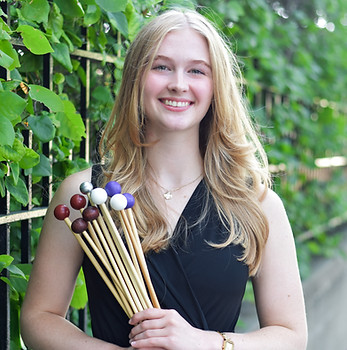
Cosette Isakson
percussion

Eri Isomura
percussion

Jason Wells
double bass

Ben Yats
percussion